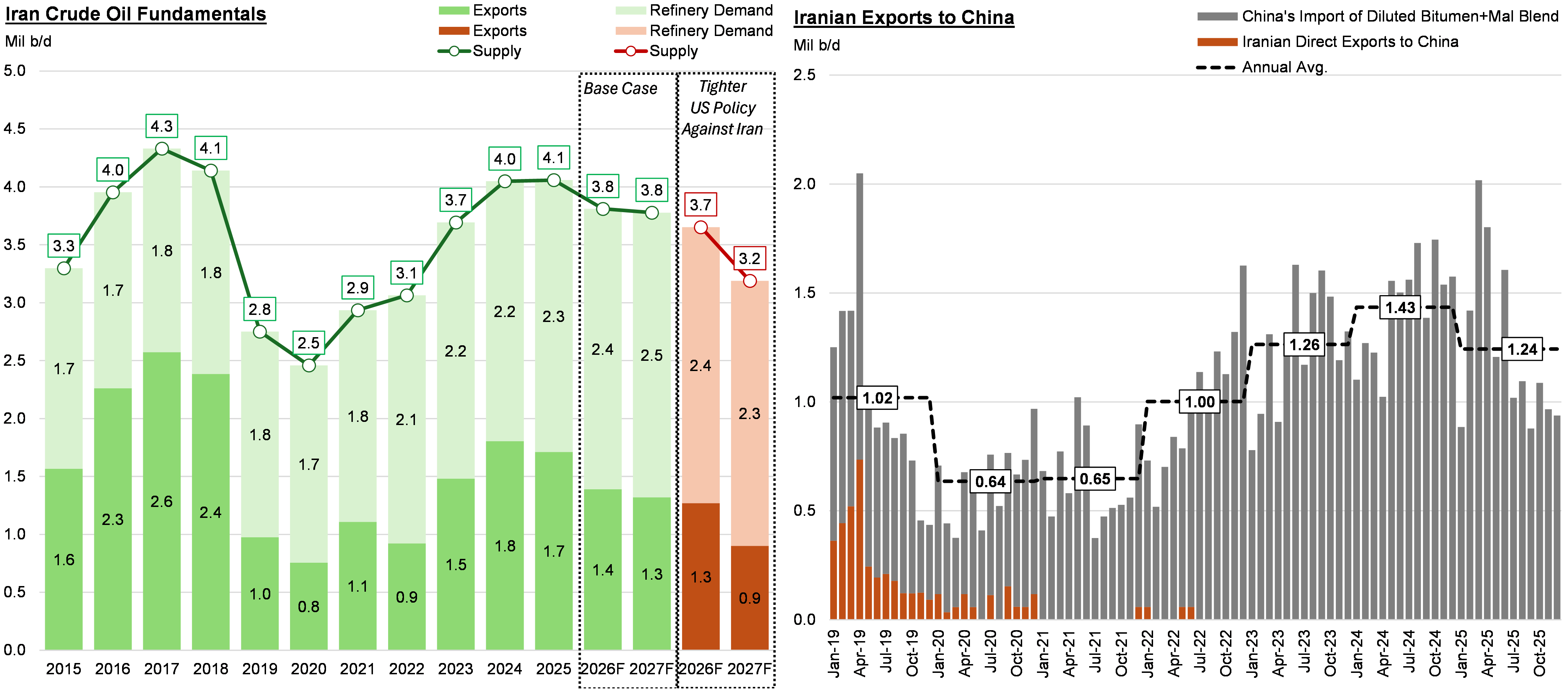

Iran’s crude fundamentals have been heavily impacted by the US sanctions policy. Following the previous US administration’s (original Trump presidency) decision in May 2018 to scrap the Obama-era Iran nuclear deal and re-impose sanctions on Iran’s oil sector, the nation’s crude production and exports both saw sharp declines, mainly during the 2019-2020 period. However, Iran’s oil sector has recovered since then, with production and exports nearly doubling, reaching similar levels as in the 2015-2016 period. The main importer of Iranian crude since 2019 has reportedly been China – according to UANI, the Iranian origin of oil is concealed by rebranding as either Omani Crude, Iraqi Crude, Russian Urals, Bitumen Blend, Nemina, or Malaysian Blend, before passing through China’s Customs to independent refineries in Northern China, also being referred to as “teapot” refineries. As US naval forces compile in the Middle East, Iran was recently struck down by the US Navy, and with ongoing instability within Iran, tensions continue to increase between the US and Iran. Despite all of this and the plethora of headlines over the past week, US-Iran talks continue in Oman. Negotiations have reportedly made progress, and a potential de-escalation and nuclear deal are becoming more likely (as of Friday, February 6th, 2026). Even with a potential deal between the two countries, continued pressure and sanctions are expected to pile on Iran. Limiting buyers, increasing floating storage, and squeezing the Iranian regime’s petroleum export revenue.
To quantify the potential impact on export volumes, substituting flows and tanker demand, we assessed Iran’s crude sector when Trump originally reimposed sanctions (May 2018). Refinery demand and crude production did not react immediately. It took 15 months for Iranian crude production to drop to 57% of the 12 month average between Jun 2017 and May 2018, while demand slightly increased due to more available feedstocks in Iran. The following 15 months (Aug 2019 – Nov 2020) production hovered at similar levels while refinery demand also retreated amid slower economic activity. Applying these monthly ratios to the base-case forecasts on Iranian crude demand and supply, we ran impact scenarios if the Trump Administration continues to adopt tighter policies on Iran. According to our calculations, the net impact on Iranian crude exports is a decline of 500,000 b/d by 2027, leading to only 0.9 million b/d exports flowing from Iran.